A live debate moves faster than comprehension
In a live session, students track who's speaking — not whether the argument holds. Claims land and pass before anyone has time to evaluate them.
Symposya for Universities
Most students leave a seminar having heard it. Symposya gives them a way to actually understand it — with contributions ordered, claims linked to their sources, and contextual insights that fill the gaps a live discussion always leaves.
The problem
In a live session, students track who's speaking — not whether the argument holds. Claims land and pass before anyone has time to evaluate them.
Without a visible link between claims and their sources, students react to impressions. Agreement or disagreement comes from tone and confidence, not from reasoning.
Once the session ends, so does the structure. The sequence of arguments, the sources behind each claim, the responses that challenged them — gone, along with any chance to revisit them.
Every claim in context. Every argument, understood.
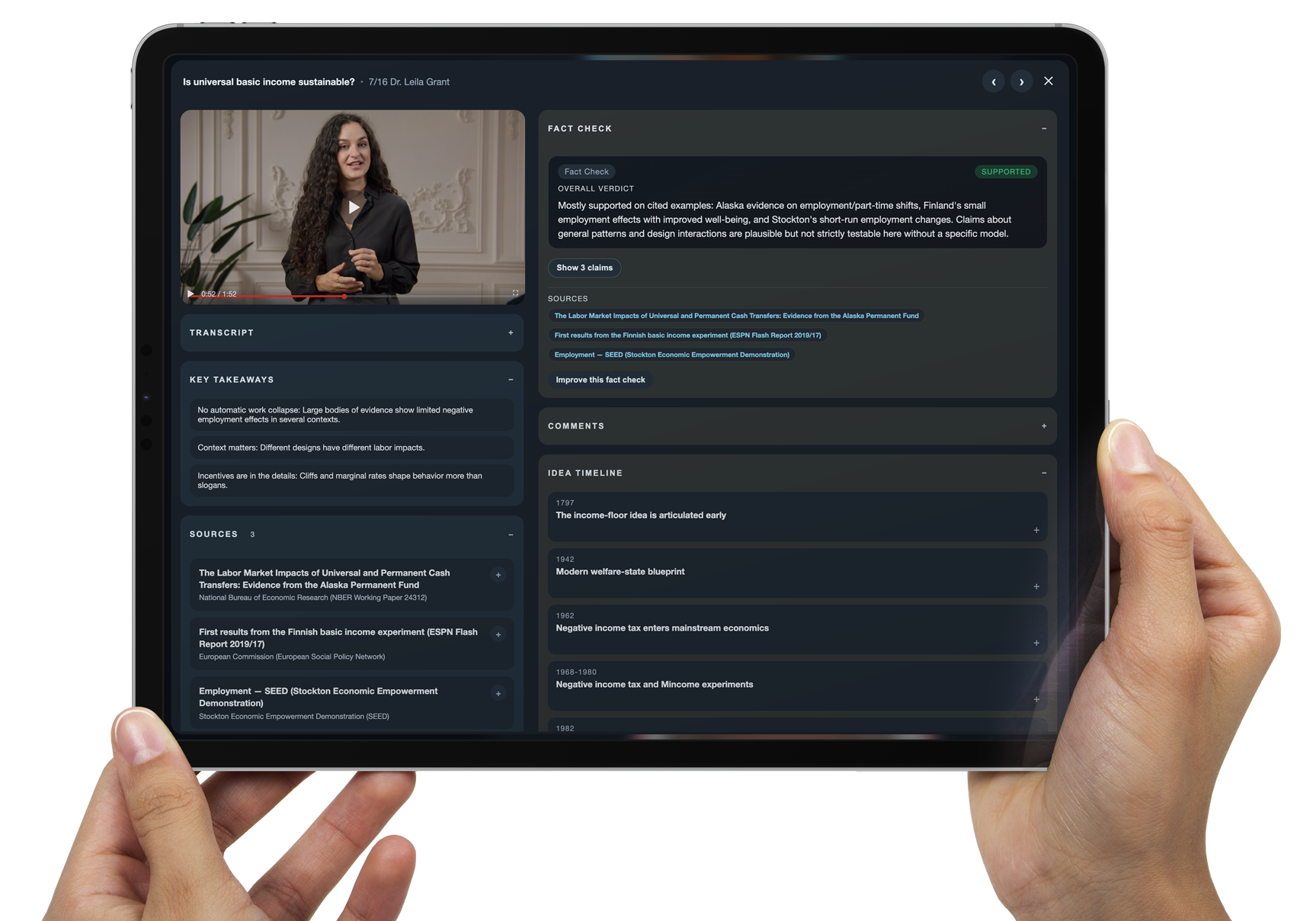
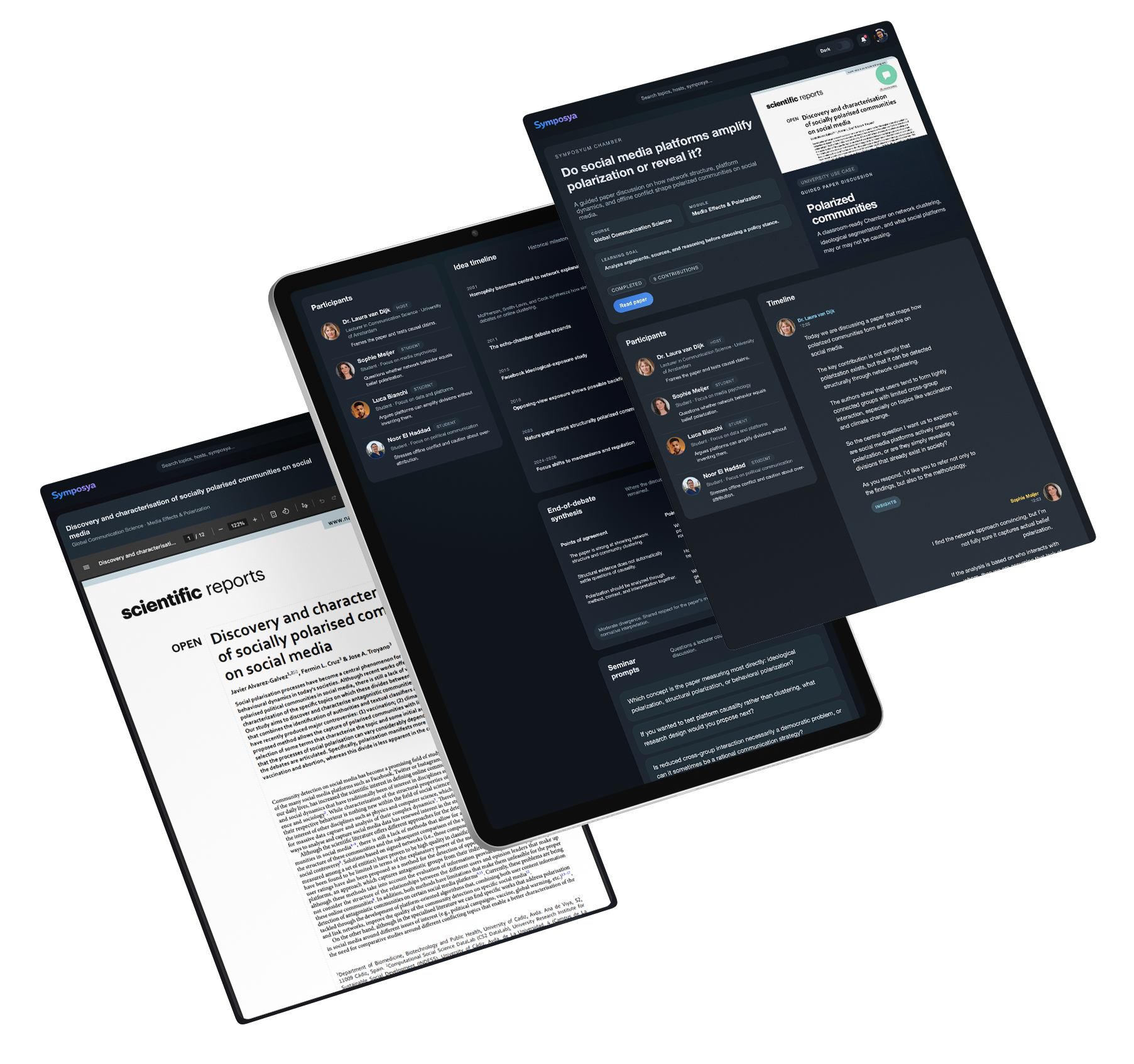
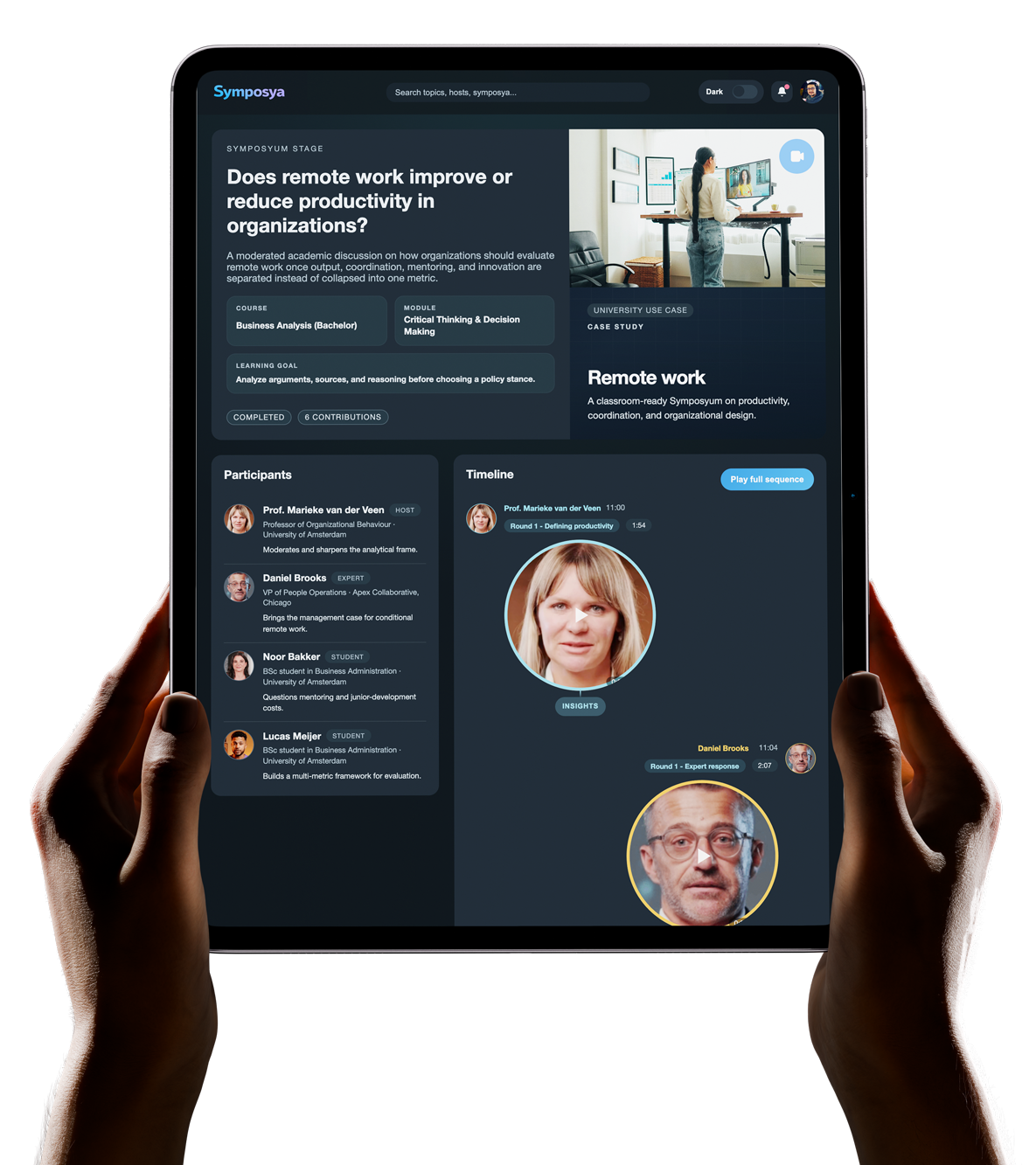
Symposya structures each debate so the reasoning is visible — not just the exchange. Contributions are ordered, claims are linked to their sources, and insight panels give students the context to understand what's actually being argued. The result is a debate you can follow, evaluate, and return to — during the session and long after.
Insights fill the gaps comprehension leaves
Contextual panels surface definitions, background, and framing in real time — so students understand what's at stake in each claim, not just what was said.
Every claim must face its source
When sources are visibly linked to the arguments they support, students stop accepting claims at face value. Evaluating evidence becomes part of following the debate.
The full argument path stays navigable after the session
Students can return to the sequence of claims and responses — revisiting the reasoning at their own pace, long after the live discussion ended.
Define topic, participants, and contribution rules. Takes under 10 minutes — no technical setup required from your IT department.
Each submission includes an argument, sources, and an optional response thread. No formatting instructions needed — the platform enforces the structure.
The debate stays live, navigable, and reusable — in this semester and the next.
See it in action
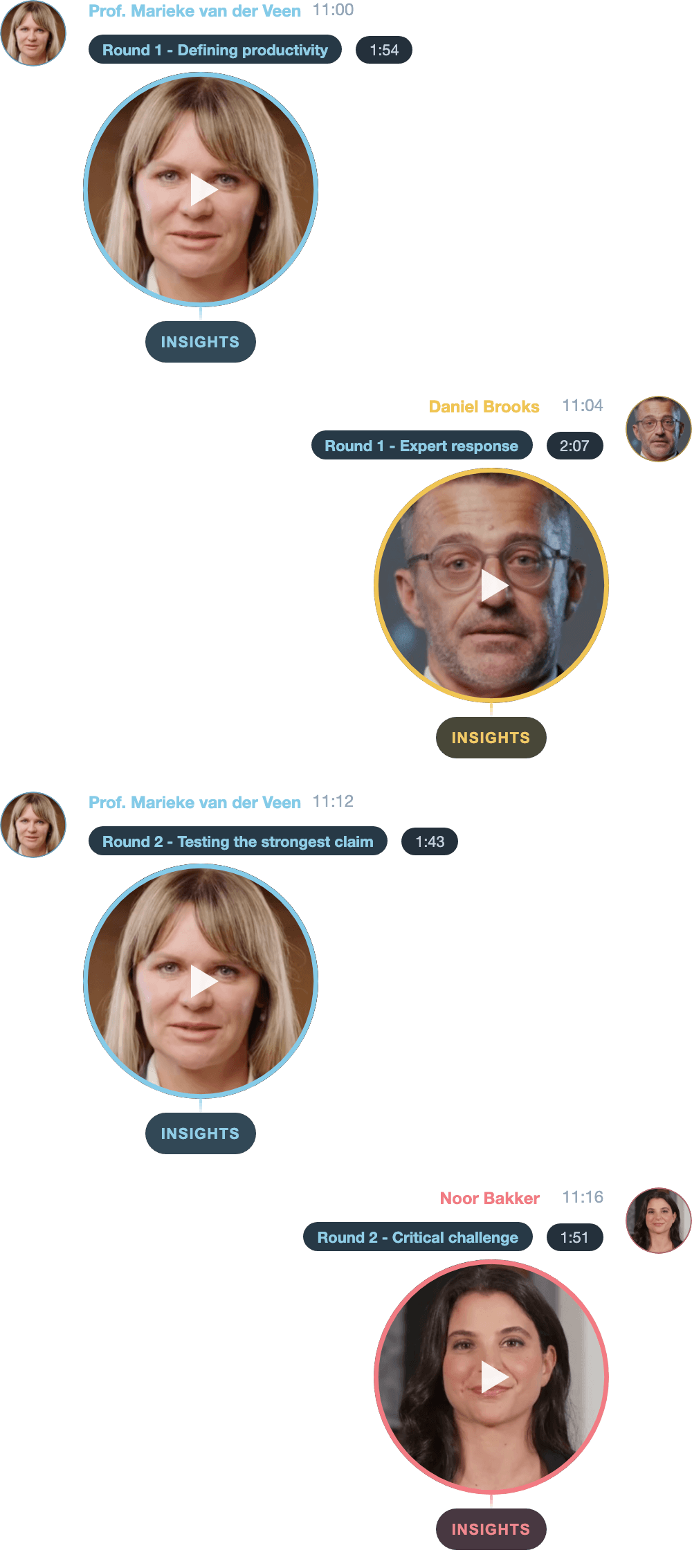
A live example of how Symposya structures a course debate — with visible reasoning, source-linked claims, and insight panels students can open at any point.
Bonus: bring in past content
Import a recorded, transcribed, or documented seminar and Symposya structures it retroactively. Contributions get ordered, sources attached, and the whole exchange becomes navigable and expandable.
For the institution
Every structured debate becomes a permanent asset. The same content supports next year's cohort, a parallel section, or an online course. The value doesn't disappear when the session ends — it accumulates.
Symposya makes the reasoning process visible — not just the final grade. Institutions can track how students argue, what sources they use, and where the reasoning breaks down. A verifiable record of analytical development.
Structured, navigable academic debate is not standard. Universities that implement it can demonstrate a concrete commitment to rigorous thinking — to prospective students, research partners, and accreditation bodies.
Pilot programme
We work with one faculty or department. You define the scope, we handle the setup. The result is a clear picture of what structured academic debate looks like in your institution — and whether it fits.
We keep pilots focused so every implementation gets direct attention and produces results worth measuring.
Course-linked debate formats, designed together with your faculty, tailored to your teaching context.
Joint setup, mid-point check-in, and end-of-pilot review with outcomes you can take back to your institution.